Elevators have always been considered a critical part of a building’s life safety infrastructure. For decades, emergency communication inside an elevator primarily consisted of a simple voice call initiated by pressing a Help button. While effective for its time, that model provided very little information to emergency responders and often left both passengers and monitoring personnel with more questions than answers.
Today, that is changing.
New requirements within the ASME A17.1-2019 Safety Code for Elevators and Escalators are redefining what emergency communication should look like. Across the country, building owners, elevator companies, and security dealers are beginning to adopt systems that combine live video, two-way communication, accessibility features, and internet-based monitoring to create a safer experience for everyone involved.
For security dealers, these changes represent more than a code update—they represent a growing opportunity to provide additional value to commercial customers while partnering with a monitoring center equipped to support these evolving technologies.
From Emergency Phone to Intelligent Monitoring
Traditional elevator emergency phones served one purpose: establish voice communication with someone outside the elevator.
While that remains important, voice communication alone often leaves operators trying to determine the severity of a situation with limited information.
Is someone injured?
Is the passenger experiencing a medical emergency?
Is there a mechanical issue?
Is there more than one person inside the cab?
Is the call accidental?
Without visual confirmation, operators are forced to make critical decisions based almost entirely on conversation.
Modern elevator monitoring changes that equation.
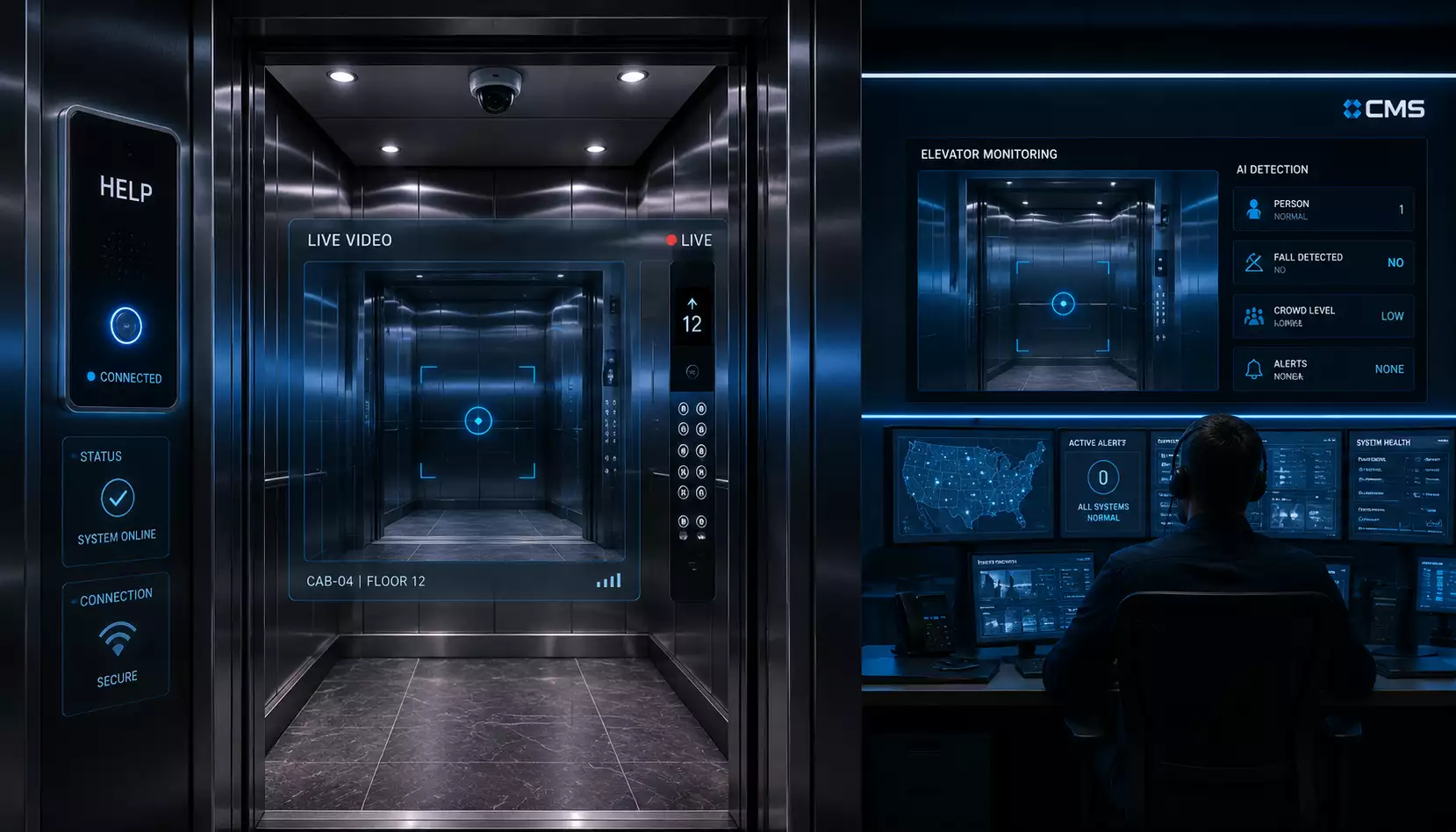
Today’s systems allow trained monitoring professionals to receive live video from inside the elevator while communicating directly with passengers. Instead of guessing, operators can immediately assess the situation and coordinate the most appropriate response.
Why Video Makes Such a Difference
During an elevator emergency, every minute matters.
Live video gives monitoring operators situational awareness that simply wasn’t possible with voice-only communication.
They can quickly determine whether:
- A passenger has fallen or requires medical assistance
- Someone is trapped but otherwise safe
- Multiple passengers are involved
- A child or vulnerable adult is alone
- There are signs of panic or distress
- The elevator appears to be experiencing a mechanical malfunction
That information allows emergency responders to arrive better prepared and helps eliminate unnecessary uncertainty during what is often a stressful situation.
Video doesn’t replace emergency communication.
It enhances it.
Accessibility Is Now Part of the Conversation
One of the most significant advancements in the latest elevator monitoring requirements is the increased emphasis on accessibility.
Not every passenger can communicate effectively using voice alone.
Modern emergency communication systems are designed to support individuals who are deaf, hard of hearing, non-verbal, or experiencing other communication challenges.
Many newer systems now provide:
- Two-way text communication
- Visual confirmation that help has been contacted
- Passenger response prompts
- Accessible interfaces designed for ADA compliance
These capabilities ensure that every passenger has a reliable way to communicate during an emergency—regardless of their abilities.
Safety should never depend on a person’s ability to speak.
A Better Experience for Everyone
While much of the discussion around elevator monitoring centers on compliance, the biggest benefit may simply be a better passenger experience.
Being trapped inside an elevator can be frightening.
Knowing that someone can immediately see you, speak with you, and provide updates dramatically reduces uncertainty and anxiety.
Some systems now allow monitoring personnel to update display messages inside the elevator, letting passengers know that help has been dispatched and is on the way.
Those simple reassurances can make an enormous difference during an emergency.
Technology isn’t replacing people.
It’s helping people provide better care.
What This Means for Security Dealers
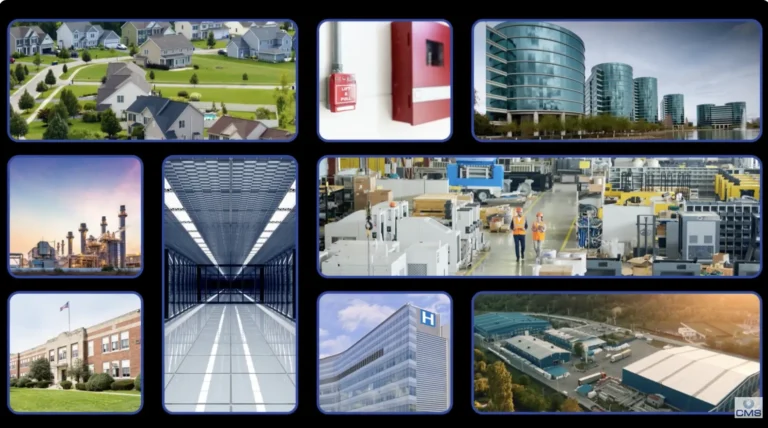
For security dealers serving commercial properties, hospitals, hotels, office buildings, educational facilities, and multi-family housing, elevator monitoring is becoming an increasingly important part of the overall security conversation.
Customers are asking new questions:
- Are our elevators compliant?
- Can emergency responders see what’s happening?
- Is the system accessible?
- Who answers these calls?
- How quickly can someone respond?
Providing the hardware is only part of the solution.
Dealers also need a monitoring partner capable of supporting video verification, two-way communications, emergency escalation procedures, and 24/7 response.
As these technologies become more common, monitoring expertise becomes just as important as the equipment itself.
Every elevator emergency involves a person—not just a piece of equipment.
Why Monitoring Matters
Every elevator emergency involves a person.
The monitoring center becomes the first point of contact between that passenger and the outside world.
That means operators must be prepared to remain calm, gather critical information, coordinate emergency response, and reassure passengers until help arrives.
It also requires resilient infrastructure capable of supporting uninterrupted communication when people need it most.
Reliable monitoring is not simply about receiving a signal.
It’s about helping people through some of the most stressful moments they may ever experience.
Why Dealers Choose CMS
As elevator monitoring continues to evolve, dealers need more than a central station—they need a monitoring partner that understands life safety, video verification, and mission-critical communications.
CMS provides 24/7 monitoring through three fully redundant, UL Listed and FM Approved monitoring centers designed for exceptional reliability. Our highly trained operators are experienced in managing complex emergency situations with professionalism, urgency, and compassion.
Whether responding to commercial fire alarms, video verification events, environmental monitoring, or elevator emergencies, CMS is built around one principle:
Deliver the right information to the right people at the right time.
As new elevator technologies continue to reshape emergency communications, CMS helps dealers confidently expand their offerings while providing customers with the dependable monitoring they expect.
The Future of Elevator Monitoring
Elevators have evolved dramatically over the past century.
Emergency communication is evolving with them.
Live video.
Accessible communication.
Real-time monitoring.
Smarter emergency response.
These aren’t simply new features.
They represent a safer standard for protecting building occupants.
For security dealers, now is the time to understand these changes, educate customers, and partner with a monitoring provider prepared to support the next generation of elevator monitoring.
Because when someone presses the Help button, they’re not just initiating a call.
They’re counting on someone to answer.