
Video monitoring has changed dramatically in a relatively short period of time.
Not long ago, cameras primarily served one purpose: record what happened. Someone would review the footage after an incident, identify what occurred, and use the video as evidence.
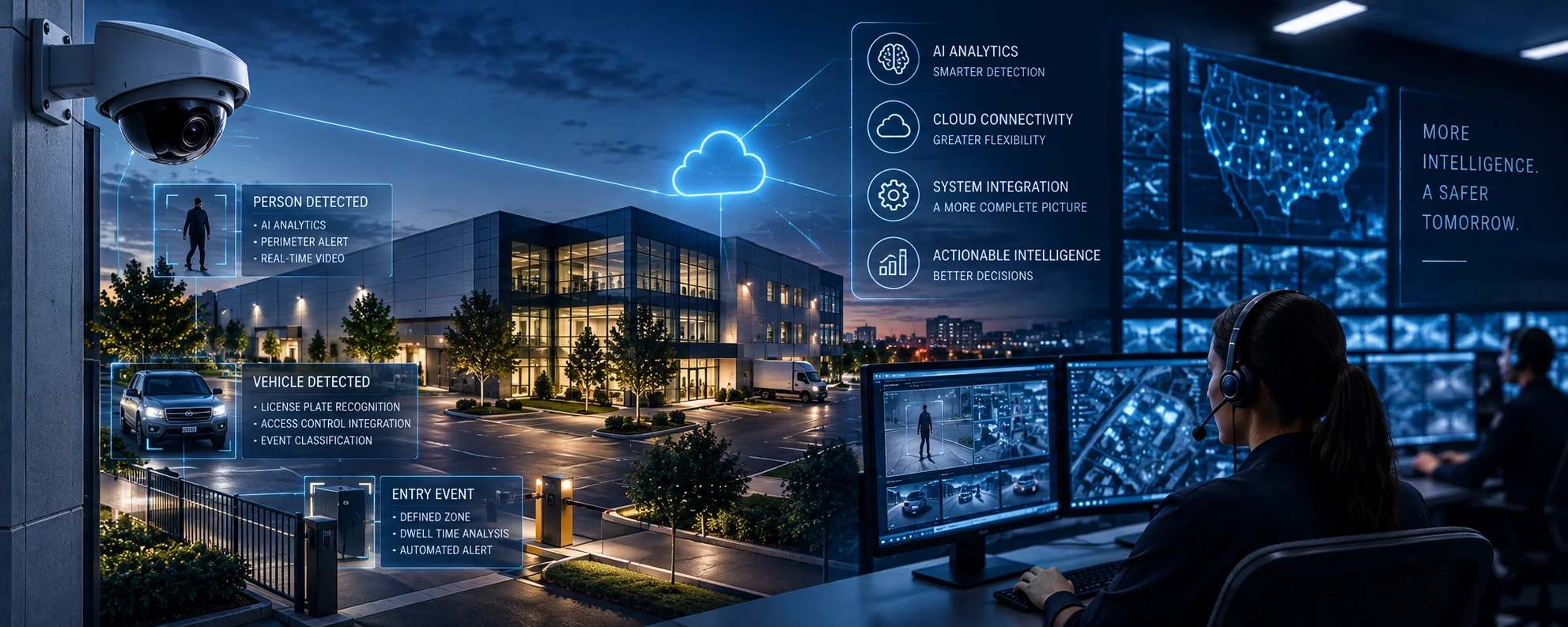
Today’s systems can do much more. Modern cameras and analytics can identify people and vehicles, monitor defined areas, recognize unusual activity, prioritize events, and deliver relevant video to monitoring professionals in seconds.
Artificial intelligence is accelerating that evolution even further.
But the most important change isn’t simply that cameras are becoming smarter. It’s that video is becoming more actionable.
From Recording Events to Understanding Them
Traditional surveillance systems generated enormous amounts of video. The challenge was determining which moments actually mattered.
Emerging video analytics are beginning to solve that problem. Instead of treating every movement the same, intelligent systems can evaluate activity against defined criteria.
- Is a person entering a restricted area?
- Is a vehicle present after hours?
- Has someone remained in one location longer than expected?
- Has activity occurred inside a protected perimeter?
By identifying these events automatically, modern video systems can direct attention toward situations that deserve closer evaluation. That fundamentally changes the role of video. The system isn’t simply documenting activity. It’s helping identify what may require action.
AI Is Improving the Signal-to-Noise Ratio
One of the biggest challenges in security monitoring has always been unnecessary alarms. Weather, animals, changing light, routine traffic, employees performing normal activities—all can potentially generate events depending on the system and environment.
Artificial intelligence and advanced analytics can help reduce that noise by providing additional context. Instead of simply asking, “Did something move?” a more intelligent system can begin asking:
- What moved?
- Where did it move?
- When did it happen?
- Does this activity match the conditions we’ve defined as important?
The better systems become at answering those questions, the more effectively monitoring professionals can focus on meaningful events. For dealers, that can mean a better customer experience and a more scalable video monitoring operation.
Edge Intelligence Is Moving Decisions Closer to the Camera
Another important development is the growth of edge analytics.
Historically, video often had to be transmitted to another system before it could be analyzed. Increasingly, cameras and on-site devices are capable of processing information locally. That can allow systems to identify events closer to where they occur and transmit only the information that matters.
The potential benefits include:
- Faster event identification
- Reduced bandwidth requirements
- More efficient video transmission
- Quicker access to relevant footage
- Greater system scalability
As edge processing becomes more capable, cameras are evolving from passive sensors into intelligent devices within the larger security ecosystem.
Cloud Connectivity Is Changing How Video Is Managed
Cloud technology is also reshaping video monitoring.
Instead of relying entirely on local systems, cloud-connected platforms can give dealers and customers greater flexibility in how video is accessed, managed, and integrated.
Authorized users may be able to manage multiple sites remotely. Monitoring centers can receive events from geographically distributed properties. Software updates and analytics can become easier to deploy across large camera networks. And different security technologies can increasingly share information through connected platforms.
For dealers managing multi-site commercial customers, this creates significant opportunities. A video monitoring program can become easier to scale without requiring every location to operate as an isolated system.
Automation Can Make Monitoring More Efficient
Emerging technology isn’t only changing what cameras can see; it’s also changing what happens after an event is detected.
Automation can help perform routine tasks such as:
- Classifying events
- Routing alerts
- Gathering associated video
- Applying predefined workflows
- Notifying designated contacts
- Documenting event activity
Used correctly, automation allows trained monitoring professionals to spend more time evaluating situations and less time performing repetitive administrative steps.
The objective isn’t to remove people from the monitoring process. It’s to make people more effective.
AI Doesn’t Eliminate the Need for Human Judgment
This distinction is important. Artificial intelligence can identify patterns. Analytics can classify objects. Automation can initiate workflows. But security events often require context.
A person standing near a commercial entrance may be an employee arriving early, or it may be an unauthorized individual attempting to gain access. A vehicle entering a property may be expected, or it may represent a threat.
A system may be able to identify what is happening visually. Understanding what that activity means often requires additional information and human judgment. That is why CMS sees AI as an enhancement to professional monitoring—not a replacement for it. Technology helps find the event. People determine what it means.
Better Technology Requires Better Operations
As video systems become more sophisticated, the operation supporting them becomes even more important. More intelligence can mean more data, more integrations, more workflows and more potential actions.
Dealers need a monitoring environment capable of managing that complexity consistently. That includes:
- Trained video operators
- Defined response procedures
- Reliable technology infrastructure
- Redundant monitoring operations
- Scalable event handling
- Strong dealer support
Advanced technology creates the opportunity, operational discipline turns that opportunity into dependable protection.
What Emerging Technology Means for Dealers
For security dealers, the rapid evolution of video creates both opportunity and responsibility.
Customers increasingly expect smarter systems. They want fewer unnecessary alerts, better visibility, remote access, more proactive security and faster information when something happens.
Meeting those expectations can help dealers create higher-value services and additional recurring revenue.
But success requires choosing technology that solves real customer problems—not simply adopting new features because they’re new. Dealers should ask:
- Does this technology improve detection?
- Does it reduce unnecessary events?
- Does it improve operator decision-making?
- Can it integrate with existing systems?
- Can it scale across customers and locations?
- Does it ultimately improve the security outcome?
Those questions help separate useful innovation from technology for technology’s sake.
Why CMS
CMS continues to invest in technologies that help dealers deliver more intelligent monitoring while maintaining the professional expertise behind every response.
That means supporting advanced video platforms, emerging analytics, connected systems, automation, and new monitoring workflows while keeping experienced operators at the center of critical decision-making.
Behind that technology are three fully redundant monitoring centers and an operational environment built to support critical monitoring around the clock.
Because innovation isn’t valuable simply because it’s new. It’s valuable when it helps deliver better protection.
The Future Is Proactive
Video surveillance once told customers what happened. Modern video monitoring can help them understand what is happening. The next generation may increasingly help identify what is about to happen.
- AI
- Edge intelligence
- Cloud connectivity
- Automation
- Advanced analytics
Each technology is moving video further away from passive recording and toward proactive security. For dealers, that shift represents one of the industry’s most significant opportunities. And for monitoring providers, it creates an equally important responsibility: Use technology to make protection smarter without losing the human expertise that makes response effective.
Because the future of video monitoring isn’t simply more technology. It’s better intelligence, better decisions and ultimately, better protection.